
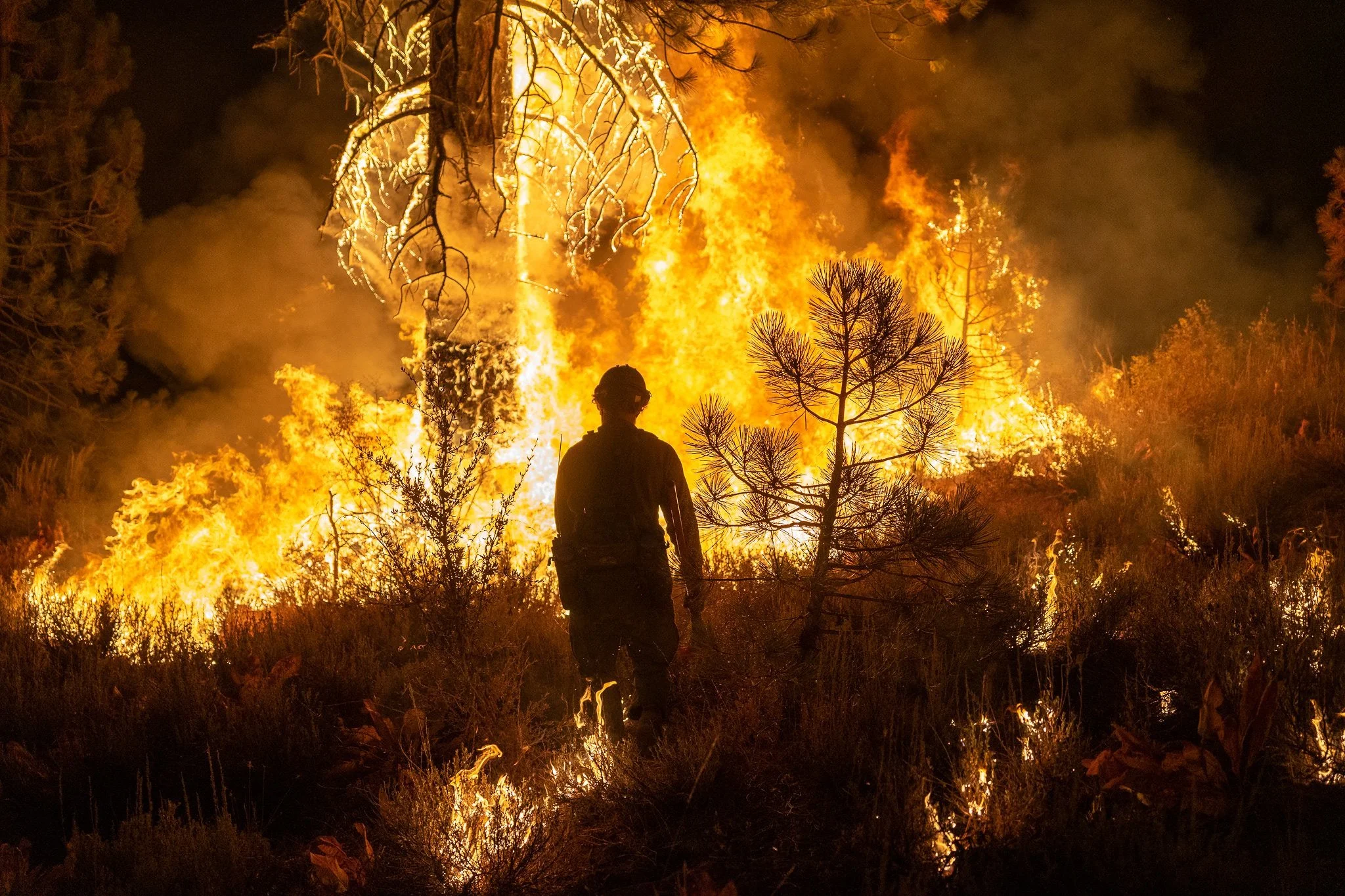

More than 160 Western Local Elected Officials Call for Action On Wildfire Preparedness
“Public land agencies must have the resources and staffing necessary to conduct robust, year-round wildfire preparedness work, including pre-fire mitigation activities, fire suppression, and post-fire recovery and resilience-building.”
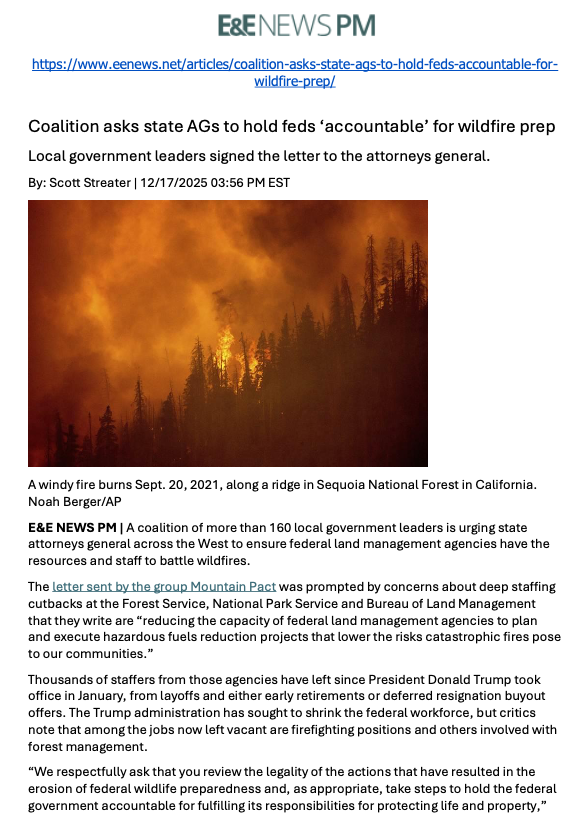
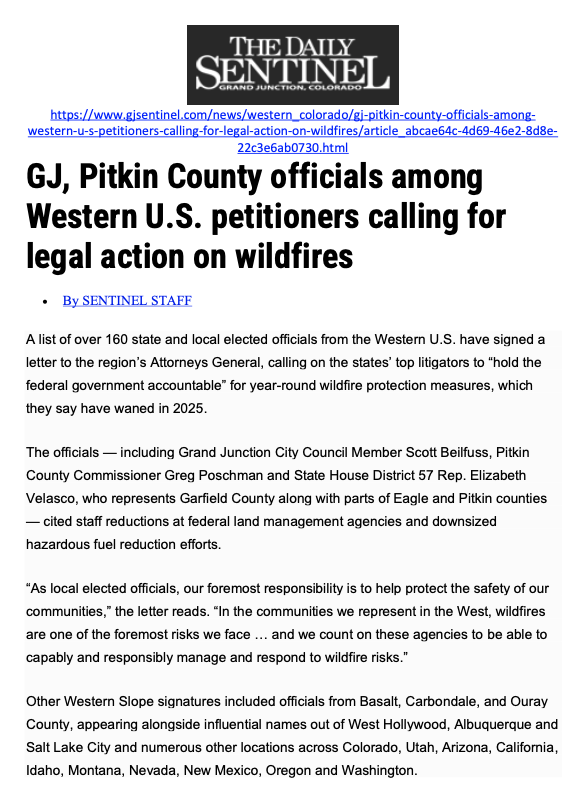
On December 17, 2025, more than 160 elected officials from across the Western United States today are calling on their state Attorneys General to hold the federal government accountable for its reckless gutting of our nation’s wildfire preparedness.
In a letter, the leaders asked Western Attorneys General to help defend their communities from potentially catastrophic wildfires by reviewing the legality of government’s actions that have eroded federal wildfire preparedness, and to ensure the federal government fulfills its responsibilities for protecting life and property in the face of increasingly severe wildfires.
“Wildfire preparedness is a matter of life and death in rural Western communities, and we depend on federal agencies being able to keep our homes, families, and property safe when wildfires strike,” said Mountain Pact Executive Director Anna Peterson. “But the federal government’s reckless and illegal firings of thousands of public land agency employees, as well as budget cuts and other shortsighted management practices, have left our communities vulnerable. We need the federal government to manage and mitigate the real risks wildfires post to our communities, instead of focusing on vindictive culture wars that waste time and resources and leave our communities less safe.”
Communities in the West depend on federal agencies like the U.S. Forest Service (USFS) and the Bureau of Land Management (BLM) to capably and responsibly manage and respond to wildfire risks. But reckless and potentially illegal cuts to federal public land management agencies and hazardous fuels reduction efforts, on top of increased risks from climate change, have left them vulnerable.
Layoffs, voluntary deferred resignations, and early retirements of land management professionals at USFS, NPS, and BLM have severely hampered the federal wildland firefighting force. With these staff reductions, there are many fewer experienced “red card” holders who are able to deploy to manage the most dangerous wildfires.
According to internal national data obtained by ProPublica “more than 4,500 Forest Service firefighting jobs — as many as 27% — remained vacant as of July 17, 2025” during the heart of wildfire season in the West. NPS and BLM reportedly faced similar constraints on hiring seasonal firefighters this year. These cuts have reduced the capacity of federal land management agencies to plan and execute hazardous fuels reduction projects that lower the risks catastrophic fires pose to our communities.
Hazardous fuels reduction work across US Forest Service lands, including mechanical thinning and prescribed fire, is down 38% as of October 1, 2025, compared with the same period over the previous four years. Public land agencies must have the resources and staffing necessary to conduct robust, year-round wildfire preparedness work, including pre-fire mitigation activities, fire suppression, and post-fire recovery and resilience-building.
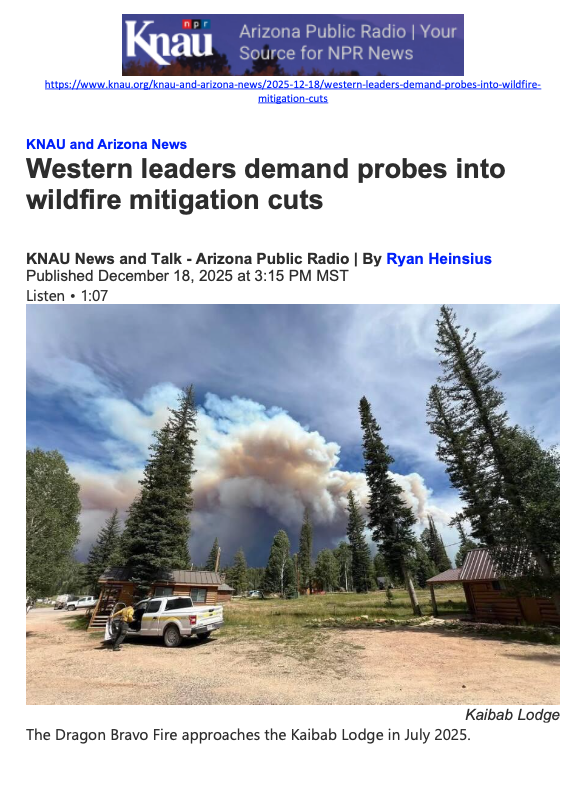
Coconino County, Arizona Supervisor Patrice Horstman said, "This year the Dragon Bravo Fire, one of the largest blazes in Arizona history, tore through the Kaibab National Forest and Grand Canyon National Park, devastating parts of the North Rim and burning hundreds of thousands of acres. As climate-induced drought continues ravaging the West, communities like mine are becoming even more vulnerable to devastating fires like this one - and federal cuts to public land management are only making the situation more dire. Wildfires are not just a seasonal threat but a growing year-round danger, and we cannot afford to weaken the federal firefighting force. I am urging the administration to end its attacks on the federal workforce, and to take serious action to restore and strengthen wildfire preparedness across the West."
City of Malibu, California Council Member Haylynn Conrad said, "California’s wildfire challenges demand robust federal support - but President Trump's reckless cuts to wildfire mitigation means hazardous fuels treatment in the state has fallen to just 34% of recent averages. Slashing federal land management agencies and undermining proactive wildfire mitigation efforts is putting Western communities like mine in danger. Without enough firefighters and hazardous fuel reduction work, our homes and our property is at risk. We need the federal government to provide the resources we need to protect our homes and families."
La Plata County, Colorado Commissioner Marsha Porter-Norton said, "Colorado communities across the state are exposed to the increasing risk of catastrophic wildfires. With federal staffing cuts and uncertainty, the ability to collectively manage and mitigate these threats is seriously compromised. Rural communities like mine depend on federal agencies to fulfill their obligations to protect lives, watersheds, people and landscapes. I am urging the federal government to reinvest in essential wildfire preparedness and to make sure we have the resources we need to keep our communities safe."
City Santa Fe, New Mexico Mayor Alan Webber said, “Unfortunately, New Mexico has suffered enormous damage from wildfires, with enormous costs to our families, forests, and wildlife. That’s why the administration’s moves to undermine wildfire preparedness is putting our homes, forests, and property in grave danger. Santa Fe and communities across the West cannot withstand the consequences of these shortsighted decisions. We need immediate action to restore federal wildfire management capacity and fulfill the government's obligation to protect our communities."
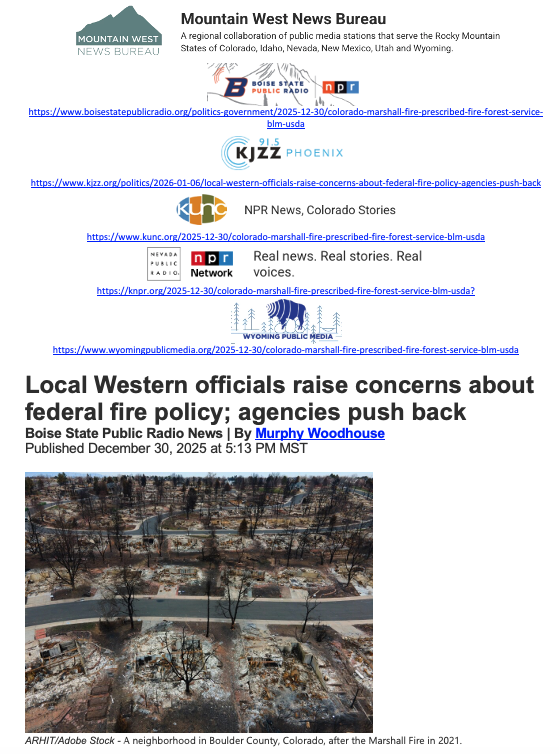
Town of Superior, Colorado Council Member Jenn Kaaoush said, “As a Councilmember and a survivor of the Marshall Fire, I know what it means for a community to be changed forever in a single afternoon. More than a thousand families in my town lost their homes in hours, and years later many are still trying to rebuild their lives. Since then, I have advised residents and local leaders in Lahaina and in LA, and I have seen the same pain, the same uncertainty, and the same struggle for stability. These are not isolated stories. This is what communities across the West face when wildfire preparedness falls behind the reality on the ground. The staffing losses and reductions we are seeing at the federal level will leave more towns exposed and more families without the protection they deserve. We need federal partners who are fully equipped to prevent catastrophic fires, respond when lives are in immediate danger, and support long term recovery. Anything less leaves our communities at unacceptable risk.”
MEDIA COVERAGE

December 17, 2025
RE: Wildfire Funding in the West
Dear Western State Attorneys General,
As local elected officials, our foremost responsibility is to help protect the safety of our communities. In the communities we represent in the West, wildfires are one of the foremost risks we face.
Our communities are located near significant federal public lands — including U.S. Forest Service (USFS), Bureau of Land Management (BLM), and the National Park Service (NPS) lands — and we count on these agencies to be able to capably and responsibly manage and respond to wildfire risks.
That’s why we are writing to you today: to express our urgent concern about the rapid decline of federal wildfire preparedness in recent months, and to ask for your help in defending our communities from the impacts of reckless and potentially illegal cuts to federal public land management agencies and hazardous fuels reduction efforts.
Since the beginning of the year, we have seen substantial reductions in staffing at federal public land management agencies. Layoffs, voluntary deferred resignations, and early retirements of land management professionals at USFS, NPS, and BLM have severely hampered the federal wildland firefighting force. With these staff reductions, there are many fewer experienced “red card” holders who are able to deploy to manage the most dangerous wildfires.
Federal agencies this year were also impeded in their hiring of the thousands of seasonal firefighters who normally join their ranks during the months when wildfires are most active. According to internal national data obtained by ProPublica “more than 4,500 Forest Service firefighting jobs — as many as 27% — remained vacant as of July 17, 2025” during the heart of wildfire season in the West. NPS and BLM reportedly faced similar constraints on hiring seasonal firefighters this year.
Deep staffing cuts are also reducing the capacity of federal land management agencies to plan and execute hazardous fuels reduction projects that lower the risks catastrophic fires pose to our communities. According to an analysis of USFS data, hazardous fuels reduction work across US Forest Service lands, including mechanical thinning and prescribed fire, is down 38% as of October 1, 2025, compared with the same period over the previous four years.
These cuts and reductions are impacting Western states in many ways:
In Arizona, where one of the largest wildfires in in the state’s history tore through the Kaibab National Forest and North Rim of the Grand Canyon National Park this summer, the Forest Service has removed hazardous fuels from barely half (56%) as many acres of national forest land as it has averaged in each of the previous four years.
In California, the Forest Service has treated just 107,840 acres, or 34% of the four-year average full-year hazardous fuels reduction total.
In Colorado, the Forest Service has removed hazardous fuels from 72% of its four-year average full-year hazardous fuels reduction total.
In Idaho, where the Forest Service has treated, on average, 316,660 acres of national forestland each of the previous four years, the Forest Service has removed hazardous fuels from a mere 65,000 acres – just 21 percent of that four-year average.
In Montana, the Forest Service is barely a fourth of the way (28%) to reaching the average full-year hazardous fuels reduction total from the previous four years.
In Nevada, the Forest Service is barely a third (38%) of its way to removing hazardous fuels from as many acres of national forestland as it has averaged over the previous four years.
In New Mexico, the Forest Service has treated just 68,000 acres of national forestland – barely half (53%) of the average amount treated each of the previous four years.
In Oregon, the Forest Service treated an average of 364,000 acres annually between 2021 and 2024. As of the end of September 2025, it had completed hazardous fuels treatments on only 118,000 acres — about 32% of the recent four-year average.
Adding to the staffing challenges facing federal land management agencies, the federal government is now reportedly preparing for a massive, government-wide reorganization of firefighting operations. While some of the goals of this reorganization are laudable — including increasing firefighter pay, modernizing computer systems, streamlining how agencies contract for equipment, and facilitating more prescribed burns — the uncertainty will create an atmosphere of confusion and could lead to worse outcomes, especially in the short term.
Wildfire preparedness is a matter of life and death in rural Western communities. The danger posed by wildfires to homes, businesses, and livelihoods is ever-present. The impacts of climate change, from increased drought to hotter and more unpredictable weather, are only heightening these risks.
We need the federal government to be able to manage and confront wildfire risks on the lands it manages near our communities. Public land agencies must have the resources and staffing necessary to conduct robust, year-round wildfire preparedness work, including pre-fire mitigation activities, fire suppression, and post-fire recovery and resilience-building.
We respectfully ask that you review the legality of the actions that have resulted in the erosion of federal wildlife preparedness and, as appropriate, take steps to hold the federal government accountable for fulfilling its responsibilities for protecting life and property.
Thank you for your attention to this urgent matter.
Sincerely,
County Supervisor Patrice Horstman, Coconino County, Arizona
County Supervisor Lena Fowler, Coconino County, Arizona
County Supervisor Judy Begay, Coconino County, Arizona
Mayor Becky Daggett, City of Flagstaff, Arizona
Council Member Anthony Garcia, City of Flagstaff, Arizona
Council Member Lori Matthews, City of Flagstaff, Arizona
Council Member Austin Aslan City of Flagstaff, Arizona
Mayor Andrea Wood, Town of Patagonia, Arizona
Vice-Mayor Michael Stabile, Town of Patagonia, Arizona
District 3 Supervisor and Vice Chair Jennifer Allen, Pima County, Arizona
Council Member Miranda Schubert, City of Tucson, Arizona
Mayor Clarinda Vail, Town of Tusayan, Arizona
Supervisor Martin Porchas, Yuma County, Arizona
Council Member Randall Putz, City of Big Bear Lake, California
Council Member Haylynn Conrad, City of Malibu, California
Mayor Christine Bubser, Town of Mammoth Lakes, California
Council Member John Wentworth, Town of Mammoth Lakes, California
County District 5 Supervisor Hardy Bullock, Nevada County, California
Supervisor District 1 Heidi Hall, Nevada County, California
Council Member and Former Mayor Dave Polivy, Town of Truckee, California
Council Member and Former Mayor Dr. Courtney Henderson, Town of Truckee, California
Council Member John Erickson, West Hollywood, California
Speaker of the House of Representatives Julie McCluskie, State of Colorado
State Senator Dylan Roberts, State of Colorado
State Senator Judy Amabile, State of Colorado
Colorado State Representative House District 26 Meghan Lukens, State of Colorado
State Representative to House District 57 Elizabeth Velasco, State of Colorado
Mayor Rachael E Richards, City of Aspen, Colorado
Mayor Pro Tem John Doyle, City Aspen, Colorado
Mayor Tamra N Underwood, Town of Avon, Colorado
Council Member Kevin Hyatt, Town of Avon, Colorado
Mayor David Knight, Town of Basalt, Colorado
Council Member Hannah Berman Town of Basalt, Colorado
Trustee T.I. Slaughter, Blue River, Colorado
Boulder County Board of County Commissioners, Boulder County, Colorado
Mayor Aaron Brockett, City of Boulder, Colorado
Council Member Taishya Adams, City of Boulder Colorado
Council Member Paloma Delgadillo, City & County of Broomfield, Colorado
Council Member Stephen Gerard, Town of Breckenridge, Colorado
Trustee Michal Rosenoer, Town of Buena Vista, Colorado
Trustee Chris Hassig, Town of Carbondale, Colorado
County Commissioner Dave Armstrong, Chaffee County, Colorado
Former County Commissioner Keith Baker, Chaffee County, Colorado
County Commissioner Jodie Hartman-Ball, Clear Creek County, Colorado
County Commissioner George Marlin, Clear Creek County, Colorado
Council Member Flor Alvidrez City and County of Denver, Colorado
Mayor Gilda Yazzie, City of Durango, Colorado
Council Member Jessika Loyer, City of Durango, Colorado
Council Member Kip Koso, City of Durango, Colorado
County Commissioner Jeanne McQueeney, Eagle County, Colorado
County Commissioner Matt Scherr, Eagle County, Colorado
County Commissioner Tom Boyd, Eagle County, Colorado
Former County Commissioner Kathy Chandler-Henry, Eagle County, Colorado
Council Member Geoff Grimmer, Town of Eagle, Colorado
Council Member Gina McCrackin, Town Eagle, Colorado
Council Member Scott Schreiner, Town Eagle, Colorado
Town Trustee Frank Lancaster, Town of Estes Park, Colorado
Council Member Tricia Canonico, City of Fort Collins, Colorado
Mayor Brian Cerkvenik, Town of Fraser, Colorado
Mayor Rick Ihnken, Town of Frisco, Colorado
County Commissioner Susan Berumen, Gilpin County, Colorado
County Commissioner Sandy Hollingsworth, Gilpin County, Colorado
County Commissioner Jeff Aiken, Gilpin County, Colorado
Mayor Laura Weinberg, City of Golden, Colorado
Council Member Don Cameron, City of Golden, Colorado
Council Member Patty Evans, City of Golden, Colorado
Council Member Scott Beilfuss, City of Grand Junction, Colorado
County Commissioner District 2 Andy Kerr, Jefferson County, Colorado
County Commissioner Lesley Dahlkemper, Jefferson County, Colorado
County Commissioner Rachel Zenzinger, Jefferson County, Colorado
County Commissioner Marsha Porter-Norton, La Plata County, Colorado
County Commissioner Elizabeth Philbrick, La Plata County, Colorado
County Commissioner Matt Salka, La Plata County, Colorado
Council Member Paula Nystrom, City of Lakewood, Colorado
Council Member Isabel Cruz, City of Lakewood, Colorado
County Commissioner John Kefalas, Larimer County, Colorado
County Commissioner Jody Shadduck-McNally, Larimer County, Colorado
Mayor Dana Greene, City Leadville, Colorado
Council Member Josef Edwards, City of Leadville, Colorado
Mayor Susie Hidalgo-Fahring, City of Longmont, Colorado
Mayor Hollie Rogin, Town of Lyons, Colorado
Council Member Judith Chandler, Manitou Springs, Colorado
Mayor Billy Giblin, Town of Nederland, Colorado
Trustee Kristopher Larsen, town of Nederland, Colorado
Mayor Andrew Ward, Town of Ophir, Colorado
Mayor Pro-Tem Joan May, Town of Ophir, Colorado
County Commissioner Michelle Nauer Ouray County, Colorado
County Commissioner Jake Niece, Ouray County
Council Member Peggy Lindsey, City of Ouray, Colorado
County Commissioner Greg Poschman, Pitkin County, Colorado
Mayor John I. Clark, Town of Ridgway, Colorado
Council Member Beth Lakin, Town of Ridgway, Colorado
Council Member Polly Kroger, Town of Ridgway, Colorado
Council Member Terry Schuyler, Town of Ridgway, Colorado
Council Member Kevin Grambley, Town of Ridgway, Colorado
Council Member Josephine Scoville, Town of Ridgway, Colorado
Council Member & Planning Commission Chair Michelle Montague, Town of Ridgway, Colorado
County Commissioner Angelica Salinas, Routt County, Colorado
County Commissioner Lance Waring, San Miguel County, Colorado
County Commissioner, District 1 Anne Brown, San Miguel County, Colorado
Former County Commissioner Linda Luther-Broderick, San Miguel County, Colorado
County Commissioner emeritus Art Goodtimes, San Miguel County, Colorado
Council Member Susan Marolt, Town of Snowmass Village, Colorado
County Commissioner Nina Waters, Summit County, Colorado
County Commissioner Tamara Pogue, Summit County, Colorado
County Commissioner Eric Mamula, Summit County, Colorado
Mayor Mark Lacis, Town of Superior, Colorado
Councilmember & Marshall Fire Survivor Jenn Kaaoush, Town of Superior, Colorado
Mayor Pro Tem J. Meehan Fee, Town of Telluride, Colorado
Former Mayor Pro Tem and Council Member Todd Brown, Town of Telluride, Colorado
Mayor Travis Coggin, Town of Vail, Colorado
Council Member Jonathan Staufer, Town of Vail, Colorado
Council Member and former Mayor Kim Langmaid, Town of Vail, Colorado
County Commissioner Muffy Davis, Blaine County, Idaho
County Commissioner Chair Angenie McCleary, Blaine County, Idaho
President, City Council Kaz Thea, City of Hailey, Idaho
Council Member Tripp Hutchinson, City of Ketchum, Idaho
Council Member Courtney Hamilton, City of Ketchum, Idaho
Council Member-Elect Amy Aguirre, City of Billings, Montana
City Commissioner Shannon Wilson, City of Great Falls, Montana
Majority Whip Howard Watts III, Assemblymember, District 15, Nevada
Nevada State Assembly, District 18 Venicia Considine, State of Nevada
Chair County Commission Tick Segerblom, Clark County, Nevada
Council Member Tammy Fiebelkorn, City of Albuquerque, New Mexico
County Commissioner Barbara Baca, Bernalillo County, New Mexico
Council Member Becky Corran, City of Las Cruces, New Mexico
Former Mayor Pro Tem and Supervisor DASWCD Gill Sorg, City of Las Cruces, New Mexico
Mayor Alan Webber, City of Santa Fe, New Mexico
County Commissioner Camilla Bustamante, Santa Fe County, New Mexico
County Commissioner Hank Hughes, Santa Fe County, New Mexico
Former County Commissioner Anna Hansen, Santa Fe County, New Mexico
County Commissioner Darlene Vigil, Taos County, New Mexico
Council Member Genevieve Oswald, Town of Taos, New Mexico
Council Member Darien Fernandez, Town of Taos, New Mexico
Chair Firewise Henry Caldwell, Taos Ski Valley, New Mexico
Mayor Tonya Graham, City of Ashland, Oregon
Council Member Bob Kaplan, City of Ashland, Oregon
Mayor Melanie Kebler, City of Bend, Oregon
Council Member Mike Riley, City of Bend, Oregon
Council Member Ariel Mendez, City of Bend, Oregon
County Commissioner Phil Chang, Deschutes County, Oregon
Mayor Roger Bourke, Town of Alta, Utah
Council Member Pamela Gibson, Town of Castle Valley, Utah
Council Member Harry Holland, Town of Castle Valley Utah
Mayor-elect Gay Lynn Bennion, City of Cottonwood Heights, Utah
County Commissioner Trisha Hedin, Grand County Utah
County Commissioner Jacques Hadler, Grand County Utah
Mayor Dustin Gettel, City of Midvale, Utah
Council Member Thom DeSirant, City of Millcreek, Utah
Mayor Pam Leach Town of Rockville, Utah
Mayor Erin Mendenhall, Salt Lake City, Utah
Former Council Member Louise Excell, Town of Springdale, Utah
County Councilor Megan McKenna, Summit County, Utah
Council Member Elizabeth Porter, City of Covington, Washington
County Commissioner Heidi Eisenhour Jefferson County, Washington
Mayor Carl Florea, Leavenworth, Washington
Council Member Zeke Reister, Leavenworth, Washington
Council Member Craig Reynolds, Mercer Island, Washington
Council Member Tami Beaumont, City of Monroe, Washington
Mayor Arne O. Jorgensen, Town of Jackson, Wyoming
County Commissioner Len Carlman, Teton County, Wyoming